Your Google Business Profile Is a Storefront, Treat It Like One
For most allergy and immunology practices, the Google Business Profile is the single most-viewed page about the practice, yet it is routinely left incomplete, unmonitored, and unoptimized.
For most allergy and immunology practices, the single most-viewed page about the practice is one that few physicians ever deliberately designed, and fewer still actively manage.
The Page Patients See Before Your Website
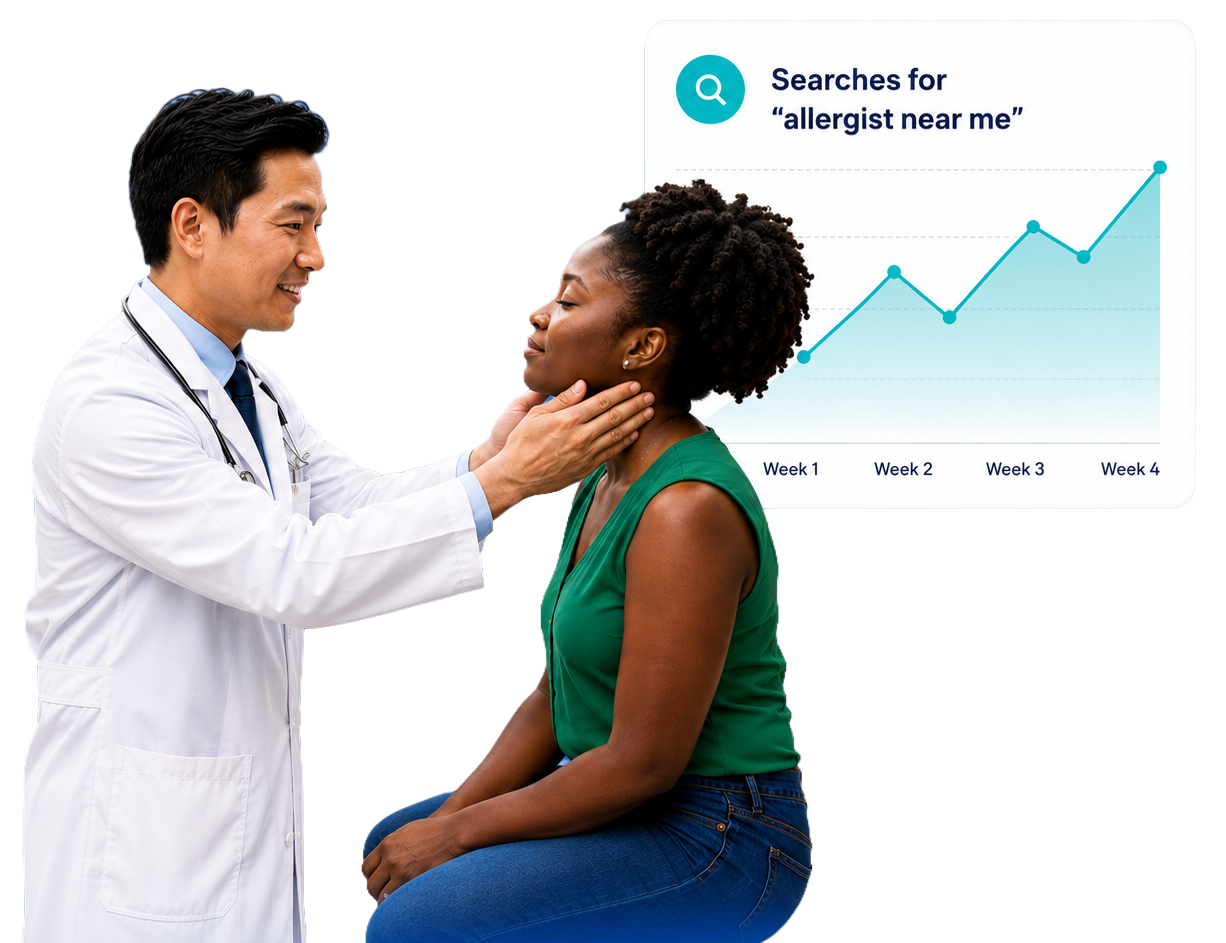
When a prospective patient searches "allergist near me" or "allergy shots [city name], " the first meaningful content they encounter is rarely the practice website. It is the Google Business Profile, the structured panel appearing in the map pack or the knowledge graph alongside the search results. This profile shows office hours, phone number, location, patient reviews, and photographs, all before a single click reaches the practice's own domain.
For an allergy and immunology practice, this matters acutely. Seasonal demand spikes are real and predictable: tree pollen in early spring, grass through late spring, ragweed in late summer and fall. Patients experiencing acute symptoms search during those windows, often on mobile, often making a decision within minutes. What they find on that profile, or fail to find, determines whether they call or scroll to the next result.
The comparison to a physical storefront is not hyperbole. A storefront with inaccurate hours, a locked door when the sign says open, or a cluttered window display drives foot traffic away silently. The same dynamic plays out digitally, without the practice ever knowing it happened.
What "Complete" Actually Means
Google defines completeness through a checklist of fields, and the algorithm rewards profiles that fill them. For a medical practice, the critical elements include the primary and secondary categories, a verified address, verified phone number, website URL, hours of operation (including holiday hours), and a substantive business description. Each of these has implications specific to specialty care.
Category selection is frequently misconfigured. "Allergist" is a recognized Google category; so is "Medical clinic." Selecting only the generic category costs the practice visibility in specialty searches. The primary category should reflect what the practice principally does, immunotherapy administration, allergy testing, asthma management, and secondary categories can layer in adjacent services.
The business description field, limited to 750 characters, is not an SEO tool in the traditional sense, keywords here do not carry significant algorithmic weight. It is, however, one of the first paragraphs a patient reads about the practice. A description that specifies the range of services (skin prick testing, patch testing, subcutaneous immunotherapy, sublingual drops, biologic infusions for severe asthma) immediately signals to the right patients that this practice handles their condition. Vague language accomplishes nothing.
Hours as a Trust Signal
Incorrect hours are among the most damaging errors a Google Business Profile can carry. Google aggregates suggested edits from users, including competitors and patients who arrived to a closed office, and may apply those edits automatically. Practices that do not monitor their profiles can find incorrect hours published without any notification.
For allergy practices, this is compounded by the structure of the week. Many practices run allergy shot clinics on specific days or at specific times separate from the main appointment schedule. If shot clinic hours differ from general office hours, the profile needs to communicate that clearly, either in the hours fields or in the "More hours" section Google provides for specific service types.
Seasonal schedule changes, lighter staffing in August, extended hours during peak spring pollen season, should be updated proactively rather than reactively. A patient who drives to a shot appointment based on hours that changed two weeks ago does not reschedule. The practice that catches this before it happens keeps that patient.
Photographs That Reflect Professional Reality
Google Business Profiles with photographs receive substantially more engagement than those without. For a medical practice, photograph selection is both a marketing and a trust decision. The relevant categories are the exterior (so patients can identify the building), the interior (waiting area, clinical spaces where appropriate), and team photographs.
Team photographs deserve particular attention in specialty care. Allergy and immunology practices often rely on long-term patient relationships, patients receiving subcutaneous immunotherapy may visit for three to five years. Seeing the providers and clinical staff in a professional photograph before the first appointment lowers the barrier of unfamiliarity. It also differentiates a practice from a generic urgent care or walk-in clinic competing for the same search results.
Avoid stock photography. Google allows users to add their own photographs to a business profile, and a profile populated with authentic practice images is harder for crowd-sourced photos to misrepresent. Practices that upload nothing create a vacuum that patient-submitted images, of varying quality and context, will fill.
Reviews: The Mechanism and the Response
Patient reviews on a Google Business Profile function as public testimony about the practice experience. Prospective patients read them; referring PCPs occasionally consult them when deciding whether to recommend a specialist. The aggregate rating and the recency of reviews both factor into how Google ranks the profile in local search results.
The ethical path to generating reviews is straightforward: ask satisfied patients, consistently and at an appropriate moment, typically after a successful outcome, a positive allergy test result explained clearly, a patient reporting symptom improvement after a season of immunotherapy, a child's first successful food challenge. Many practices generate reviews sporadically or not at all because no one has been assigned responsibility for the ask.
The response to reviews, positive and negative alike, is an underused differentiator. A thoughtful response to a critical review, composed carefully within HIPAA constraints (acknowledging the feedback without confirming or denying the reviewer is a patient), demonstrates to readers that the practice takes the patient experience seriously. Silence in response to a one-star review implies indifference. Practices with physicians who have never read their own reviews are leaving a significant reputational lever untouched.
The Q&A Section and Information Accuracy
Google Business Profiles include a public Q&A feature that allows anyone, not just the practice, to post and answer questions. This is a significant liability for medical practices that do not monitor it. Incorrect information, supplied in good faith by a past patient or a Google user guessing at an answer, can sit publicly on the profile indefinitely.
The practice should monitor Q&A regularly and seed it with preemptive answers to the questions prospective patients reliably ask: Do you accept new patients? Do you offer allergy testing for children? What insurance plans are accepted? Is a referral required? For immunology practices that administer biologic therapies for severe asthma or chronic urticaria, patients often ask what the infusion process involves, a clear, accurate answer here reduces phone call volume and sets appropriate expectations.
Answering questions the practice has authored also signals engagement to Google's systems, which factors into local ranking. The Q&A section, treated as a managed FAQ, serves both the algorithm and the patient simultaneously.
Connecting the Profile to the Practice Website
A Google Business Profile functions best as the first stop in a deliberate patient journey, not as a destination unto itself. The website URL field should point to the most relevant landing page, for most allergy practices, that is the appointments or new patients page, not the homepage, so that patients who click through land on conversion-oriented content rather than general navigation.
The profile and the website should carry consistent information: matching hours, matching phone numbers, matching service listings. Discrepancies between the two create confusion and erode trust. Google also uses consistency signals across the web, the profile, the website, directory listings, social pages, when assessing local authority. Practices with inconsistent NAP (name, address, phone) data across these sources perform worse in local search than those with tightly maintained listings.
For practices that have moved locations, changed phone numbers, or undergone a name change following a practice acquisition or merger, auditing all of these external listings is a non-negotiable step. Google may retain and surface outdated information long after the change was made internally.
Insights as a Diagnostic Tool
Google provides a data panel, Google Business Profile Insights, showing how patients are finding and interacting with the profile. The metrics include searches (how many users saw the profile), calls, website clicks, direction requests, and the search queries that triggered the profile appearance.
This data is genuinely useful for an allergy practice because it maps to seasonal demand patterns. A spike in profile views in mid-March correlates with the tree pollen season onset in most markets. A spike in phone calls following a local news story about a particularly severe allergy season is visible in the data. Practices that track this over time develop a clearer picture of when to increase appointment availability, when to promote immunotherapy initiation to patients still in consultation, and when referral inflow from PCPs typically accelerates.
Insights also reveal where the practice is losing patients to competitors. If direction requests are low relative to searches, the practice is attracting attention but not converting it. If phone call volume is low relative to website clicks, the website is failing to drive action after the initial engagement.
Looking Ahead
Consumer-driven healthcare is not a trend that will reverse. Patients are increasingly arriving with research already done, comparison-shopping specialists the way they compare products, and weighing digital reputation alongside clinical credentials. An allergy and immunology practice that manages its Google Business Profile with the same discipline applied to clinical operations, regular audits, assigned ownership, systematic review management, builds a compounding advantage over practices that treat it as an afterthought.
The mechanics described here are not complex. None require significant technical expertise or marketing budget. What they require is sustained attention and an understanding that the first impression of most practices is now digital, public, and only partially within the practice's control. Practices that choose to shape that impression deliberately are choosing to compete. Practices that do not are ceding that ground by default.