Local SEO Basics: Helping Patients Find Your Allergy Practice on Google
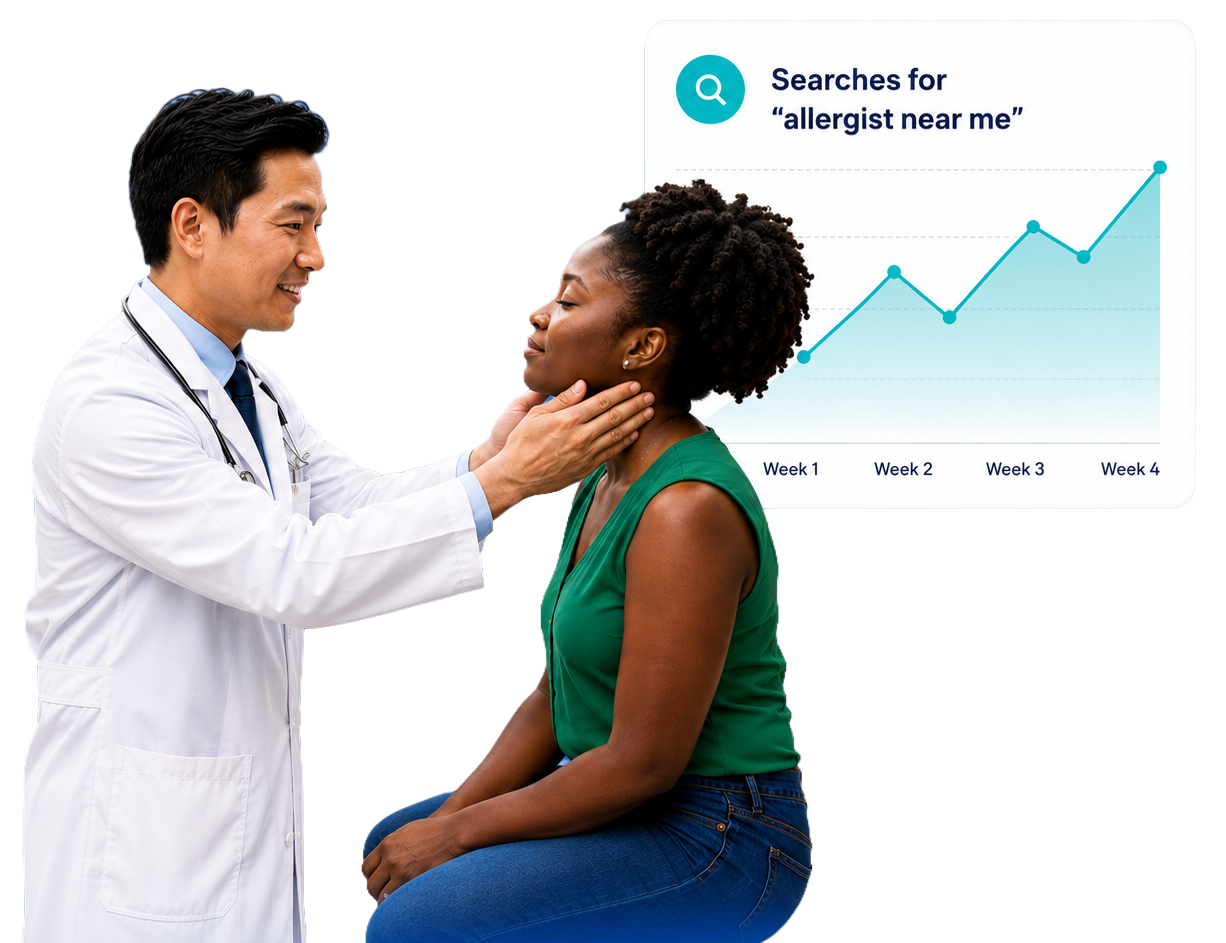
Allergists who understand local search fundamentals can capture more "allergist near me" queries and convert them into scheduled appointments, even in competitive markets.
For an allergy or immunology practice, geographic visibility on Google is not a marketing luxury, it is the primary mechanism through which patients with new or uncontrolled symptoms find a specialist, often at the exact moment their PCP has told them to seek one.
Why Local Search Matters for Allergy Practices
When a patient leaves a primary care appointment with a referral to an allergist, the next thing many of them do is open a browser and type "allergist near me" or "allergy testing [city name]." That search happens before they call the number on the referral slip, and sometimes instead of it. If a practice does not appear prominently in those results, it loses patients it never knew were looking.
Local search is distinct from general organic search. Google's local results, the map pack and accompanying business listings, are driven by a separate set of signals than traditional website rankings. Understanding that distinction is the first step toward improving visibility. A practice can have a beautifully designed website and still be invisible to patients searching within two miles of the office.
The stakes are particularly high for allergy practices because demand is intensely seasonal. Fall ragweed season and spring tree-pollen season produce sharp spikes in patient-initiated searches. Practices that have done the foundational local SEO work before those seasons arrive capture the surge. Practices that have not are invisible at the moment demand peaks.
Google Business Profile Is the Foundation
The single most impactful local SEO asset for a medical practice is the Google Business Profile (formerly Google My Business). This is the listing that appears in the map pack, populates the knowledge panel on the right side of desktop search results, and drives a large share of phone calls and direction requests from patients who have never visited the practice website.
Claiming and fully completing the profile is non-negotiable. That means verifying the business, selecting accurate primary and secondary categories (use "Allergist" as the primary category, not a generic "Medical Clinic"), entering the correct address, phone number, and hours, and uploading recent interior and exterior photos of the practice. Completeness correlates directly with ranking position in the map pack.
Hours deserve particular attention. Practices that have added telehealth availability or modified hours during the pandemic-recovery period often have outdated information in their profile. A patient who calls during what Google shows as business hours and reaches voicemail is a lost opportunity that the practice will never know about.
Consistent NAP Data Across the Web
NAP stands for Name, Address, and Phone number. Google cross-references this information across dozens of directories, Healthgrades, Vitals, Zocdoc, Yelp, the hospital system directory if applicable, the state medical board listing, and many others. When this information is consistent everywhere, it reinforces Google's confidence that the business is legitimate and accurately located. When it differs, a suite number missing here, an old phone number there, it introduces ambiguity that can suppress local rankings.
For allergy practices, the directory landscape is particularly rich. Specialty-specific platforms like Healthgrades carry significant weight in health-related local searches. These listings should be claimed, not just populated by automated data aggregators. A claimed and actively managed Healthgrades profile, for example, allows the practice to display accepted insurance plans, list services like skin prick testing, patch testing, or sublingual immunotherapy, and respond to patient reviews.
Conduct a NAP audit at least once a year. Use a simple spreadsheet: list every directory where the practice appears, record the NAP data exactly as it appears, and flag inconsistencies. Many of the corrections can be made through the individual platform's business owner portal.
Website Signals That Support Local Visibility
While the Google Business Profile is the dominant factor in map pack rankings, the practice website still matters, particularly for the organic results that appear below the map pack, and for patients who click through from the listing to learn more before calling. Several on-site elements specifically support local relevance.
Each location should have a dedicated page on the website if the practice operates multiple offices. That page should include the full address, phone number, hours, a list of services offered at that location (not all offices offer the same allergy testing panels or biologic infusion services, for example), and an embedded Google Map. Avoid pages that are thin copies of one another with only the city name swapped, Google recognizes and discounts that pattern.
The practice's NAP information on the website should be in crawlable text, not embedded in an image. It should appear in the website footer on every page, and also prominently on the Contact page. Schema markup, specifically the LocalBusiness or Physician schema, helps search engines parse and associate this structured information with the Google Business Profile.
Patient Reviews and Their Outsized Role
Review volume and average rating are among the most heavily weighted factors in local search rankings, and they also directly influence whether a patient who sees the listing decides to call. A practice with forty recent reviews averaging 4.6 stars will outrank and out-convert a practice with eight reviews averaging 4.2 stars in almost every competitive market.
The challenge for allergy practices is that satisfied patients do not naturally think to leave reviews. Patients who had a difficult experience are more motivated to write publicly. This asymmetry has to be actively managed. The most effective method is a simple, low-friction ask at the end of a positive interaction, either verbally at checkout or via a brief follow-up text message or email with a direct link to the Google review form.
HIPAA considerations apply. Staff should not reference a patient's specific condition, treatment, or appointment details in any outreach related to reviews. A neutral request, "If you had a positive experience, we'd appreciate a Google review", with a direct link is both effective and compliant. Do not offer incentives for reviews; Google's policies prohibit it and the practice risks having reviews removed.
Telehealth and Its Effect on Local Search Strategy
The pandemic period reshaped patient expectations around telehealth, and those expectations have not fully reverted. Many allergy practices now offer a hybrid model: initial consultations or follow-up medication management via video, with in-person visits for allergy testing, immunotherapy injections, or spirometry. This has local SEO implications worth considering.
Telehealth visits that serve patients outside the immediate geographic radius of the physical office can expand the practice's effective service area, but Google's local algorithm still anchors rankings to a physical address. A practice cannot claim a service area across an entire metro by offering telehealth, the physical office location remains the anchor. What practices can do is ensure their telehealth services are listed clearly on the website and in the Google Business Profile's service descriptions, so patients searching for "allergy telehealth [city]" can find them.
For allergy-specific care, telehealth has natural limits. Skin prick testing, intradermal testing, and the administration of allergy shots require an in-person visit. Patients often need to understand this before scheduling, and clear communication on the website, particularly on service pages for allergen immunotherapy, reduces wasted appointment slots and front-desk confusion.
Structured Service Pages for High-Intent Searches
Beyond the practice homepage, individual service pages allow a practice to capture patients who are searching for a specific procedure or condition rather than just a specialist type. "Allergy testing near me, " "allergy shots [city], " "asthma specialist [neighborhood], " and "food allergy testing children" are all searches that a well-structured website can answer.
Each service page should address what the service is, who is a candidate, what a patient can expect during a visit, and practical logistics like insurance and appointment scheduling. For immunotherapy pages specifically, covering both subcutaneous immunotherapy (allergy shots) and sublingual options where the practice offers them helps capture the full range of patient research behavior. Asthma pages should address both diagnostic services like spirometry and management approaches, since many asthma patients are searching for help with poorly controlled symptoms rather than a diagnosis per se.
These pages do not need to be long, five hundred to eight hundred focused words is sufficient. They need to answer real patient questions clearly, include the practice's location information, and link logically to the appointment scheduling flow.
The Role of the Front Desk in Local Search Outcomes
Local SEO generates phone calls and form submissions. What happens next determines whether that visibility produces a new patient relationship or a missed opportunity. A front desk team that answers quickly, communicates warmly, and books appointments efficiently completes the conversion that the search investment made possible.
New patient call volume should be tracked separately from other call types. If a practice invests in improving its local visibility and does not see a corresponding increase in new patient appointments, the breakdown may be in the front desk workflow rather than in the search rankings. Mystery shopping, having someone call as a prospective patient and evaluate the experience, is an underused diagnostic tool in specialty practices.
For allergy practices where demand spikes during pollen season, staffing the phones adequately during those windows is a direct revenue variable. A patient who calls during fall ragweed season and cannot get through may not call back in two weeks. They may find a competitor in the map pack instead.
Looking Ahead
Local search behavior continues to shift as mobile devices become the dominant platform for health-related queries. Searches on mobile devices are more likely to result in a phone call than a website visit, which makes the Google Business Profile's click-to-call function a critical asset. Practices that have not tested their mobile experience, loading speed, ease of finding a phone number, tap-to-call functionality, are likely leaving calls on the table.
The allergy and immunology specialty is well positioned to benefit from local SEO investment precisely because patient demand is periodic and high-intent. A patient in the middle of a severe ragweed season is not browsing, they are ready to schedule. The practices that have built their local search presence before that moment arrives are the ones that capture that patient. The fundamentals described here are not complex, but they require deliberate attention and consistency over time.