Search Is Changing: Why Helpful Content Still Wins
As search algorithms evolve and generative AI tools begin reshaping how patients find health information, allergy practices that publish genuinely useful clinical content are best positioned to maintain visibility and earn patient trust.
Search behavior and ranking algorithms continue to shift, but the practices that consistently answer real patient questions in depth are the ones that hold their ground, regardless of what changes underneath.
The Ground Has Shifted, Again
Google's Helpful Content Update, rolled out through late 2022 and into early 2023, sent a clear signal to the healthcare marketing world: pages written primarily to rank rather than to inform are losing ground fast. Sites that chased keyword density while offering thin, repetitive answers have seen traffic erosion. Meanwhile, practices and health systems that publish substantive, experience-driven content have largely held steady or improved.
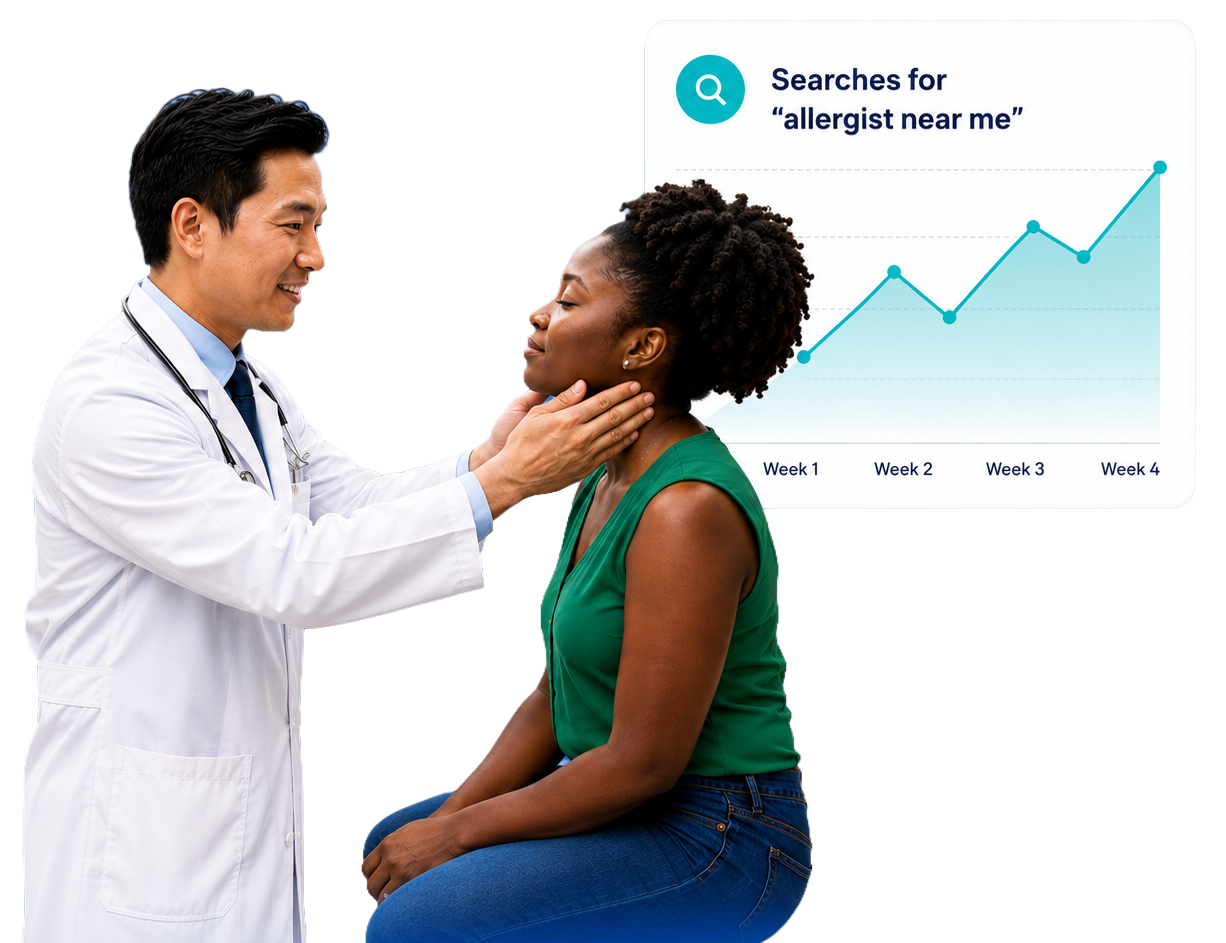
For allergy and immunology practices, the timing is instructive. Spring pollen season drives one of the most predictable and search-intensive patient journeys in all of medicine. Patients typing "itchy eyes tree pollen treatment" or "allergy shots vs allergy drops" are not browsing, they are ready to act. A page that actually explains the clinical tradeoffs of subcutaneous immunotherapy versus sublingual drops, in plain language, performs because it deserves to.
What "Helpful" Actually Means for Healthcare Content
Google's documentation on the Helpful Content system describes content written "for people, not for search engines." In practical terms, that means demonstrating genuine expertise, covering a topic with appropriate depth, and addressing the follow-up questions a patient or caregiver would naturally have. For an allergist's website, this is not a stretch, it is what good clinical communication already looks like.
A post that explains what to expect during a skin-prick allergy test, including preparation, the testing process, how results are interpreted, and next steps, answers real questions comprehensively. That format rewards the reader and, as a result, rewards the practice in search rankings. Contrast that with a short, generic paragraph about "allergy testing options" that links to a contact form, the latter satisfies no one.
Depth also means being specific about the conditions a practice treats: perennial allergic rhinitis versus seasonal disease, eosinophilic esophagitis, drug hypersensitivity, insect venom allergy, mold sensitization. Specialty-specific language, used accurately and explained clearly, signals legitimate expertise to both algorithms and readers.
The PCP Referral Path Runs Through Search
Primary care physicians are still the dominant referral source for allergists, but that pipeline is increasingly influenced by what the patient has already found online. A patient who arrives at a PCP appointment having already researched immunotherapy outcomes, or having read an authoritative explanation of biologics for severe asthma, is more likely to ask for a specialist referral, and more likely to mention a specific practice they found and trusted.
Practices that produce educational content about dupilumab, omalizumab, and related biologics, written at a level accessible to informed patients without overpromising outcomes, are positioning themselves favorably in that pre-referral moment. The content does not need to sell; it needs to explain. That distinction is exactly what the current generation of search quality signals is designed to detect.
Structured Authority: E-E-A-T in an Immunology Context
Google's quality evaluator guidelines now use the framework E-E-A-T: Experience, Expertise, Authoritativeness, and Trustworthiness. For medical content, trust is the linchpin. Pages authored by a named, credentialed allergist, with a visible biography, board certification noted, and institutional affiliations listed, start from a stronger foundation than anonymous or byline-free content.
This does not require producing academic papers. A practical post about managing exercise-induced bronchoconstriction in adolescent athletes, written by a physician who treats that population regularly, carries inherent credibility. So does a seasonal update on local pollen counts with clinical guidance on adjusting antihistamine timing or increasing controller medication before peak exposure. Both reflect genuine experience and specific knowledge that a generalist content writer cannot replicate.
Authoritativeness also accrues over time and through consistency. A practice that has published a substantive post every six to eight weeks for two years is, from a search-quality standpoint, meaningfully different from one that published fifteen posts in a burst and then went quiet. Cadence communicates investment.
Seasonal Demand Cycles as a Content Calendar Framework
Allergy practices have a natural editorial calendar that most other specialties envy. Tree pollen peaks in late winter and early spring. Grass pollen follows through early summer. Ragweed dominates late summer through first frost. Mold spore counts surge after rain and in fall leaf litter. Each transition is a predictable moment of elevated patient search activity.
Building content around those cycles, published ahead of the peak, not during it, captures patients in the consideration phase before symptoms are overwhelming and appointment slots are full. An educational post on tree pollen immunotherapy published in January or February, when patients are thinking about next season's management rather than struggling through the current one, reaches a higher-intent audience at a calmer moment.
Beyond seasonality, recurring clinical themes have durable search value. Content on anaphylaxis action plans, food allergy school accommodations, and asthma controller versus rescue inhaler distinctions answers questions that patients search year-round. A library built from both seasonal and evergreen topics compounds in value as each page accumulates time in index.
The Emerging AI Question, and Why It Changes Less Than It Seems
Early 2023 has brought significant attention to generative AI tools, with ChatGPT in particular prompting widespread speculation about the future of search. Some commentators have suggested that AI-generated answers will displace the need for ranked web pages altogether. That outcome, if it ever materializes, is many years away, and even in the most optimistic AI-search scenarios, the underlying requirement for trustworthy, specific, experience-derived content does not disappear.
If anything, AI-summarized health information surfaces the problem of generic content more acutely. A generated summary pulled from thin, repetitive web pages produces a thin, repetitive answer. The practices best positioned in any future search paradigm are those whose content is so specific, so clearly grounded in clinical experience, and so precisely tailored to patient questions that it stands apart from mass-produced filler regardless of how it is eventually surfaced.
For now, the practical guidance is straightforward: produce content that a patient would genuinely find valuable after reading, and do so with enough consistency and depth to establish a credible body of work. That strategy is robust across algorithm updates, regardless of what generative tools eventually do to the search interface.
Site Architecture Still Matters
Content quality alone is insufficient if the technical foundation is weak. Page load speed, mobile usability, and clear internal linking between related posts all affect both user experience and crawlability. An allergist's website that loads slowly on a mobile device, exactly the format patients use when searching at a pharmacy or in a waiting room, loses the audience before the content has any opportunity to perform.
Organizing content into logical topic clusters also reinforces topical authority. A central page on immunotherapy can link out to specific posts on subcutaneous versus sublingual protocols, candidate selection criteria, and what patients should know about the buildup phase. The internal architecture signals to search engines that the site has genuine breadth and depth on the subject, not just a single keyword-optimized page.
Patient Reviews as a Trust Signal
Organic search results for local practices are increasingly intertwined with review signals, particularly in Google's map-pack results. A practice with a high volume of detailed patient reviews, mentioning specific conditions treated, the thoroughness of allergy testing, and positive experiences with nursing staff during allergy shots, ranks differently in local search than one with sparse feedback.
Encouraging satisfied patients to leave reviews, as part of a systematic follow-up workflow rather than a one-off ask, builds this signal steadily. The content of those reviews also reinforces E-E-A-T signals when reviews mention specific clinical services by name. This is not a content strategy in the traditional sense, but it is part of the same ecosystem that determines how search surfaces a practice to new patients.
Looking Ahead
Search will continue to evolve. Feature snippets, knowledge panels, and whatever AI-assisted interfaces eventually reach widespread deployment will all reshape how patients interact with search results. None of that changes the underlying requirement for content that accurately, specifically, and helpfully addresses the questions patients actually have about allergy testing, immunotherapy, asthma management, and biologic therapies.
Practices that treat their website as a genuine educational resource, not a digital brochure, are building something that holds value across whatever format changes come next. The algorithm updates of 2022 and early 2023 did not invent a new standard; they enforced an old one. Good clinical communication, published consistently and structured for readability, has always been what patients and physicians needed. Search is finally, if imperfectly, learning to reward it.