Zero-Click Search and the New Front Door to Your Practice
As more patients get their answers directly from search engine results pages without ever visiting a website, allergy practices need a new strategy for being found and trusted before the click ever happens.
Search engines have quietly shifted from directories of links to direct answer engines, and for allergy practices this means the competition for patients now plays out on the results page itself, before anyone visits your website.
The Search Landscape Has Shifted
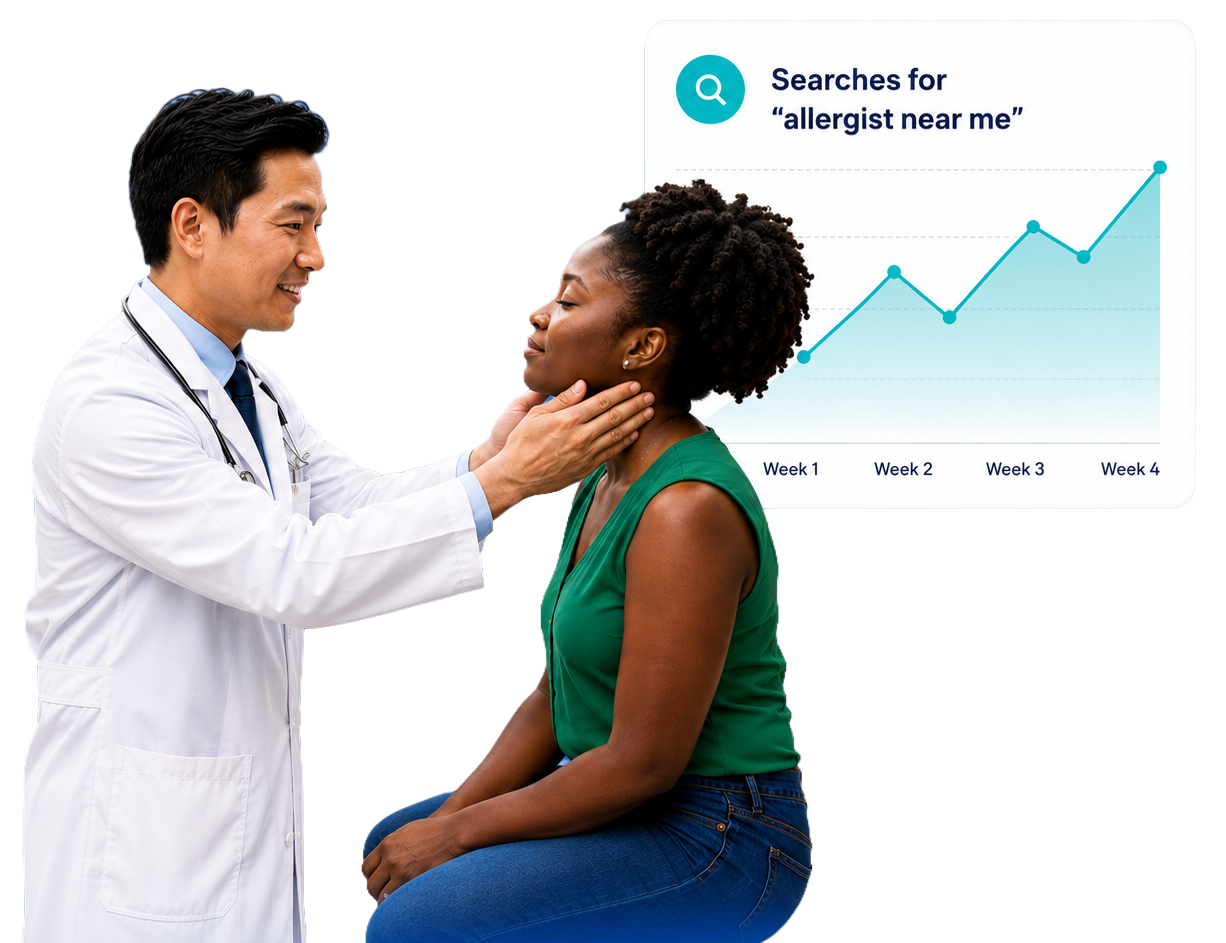
For most of the internet's history, search engines functioned as a referral service. A patient typed "allergist near me" or "what causes spring allergies, " the engine returned a ranked list of links, and the patient clicked through to learn more. Website traffic was the currency of visibility.
That model has been eroding for several years and accelerated sharply around 2022 and into 2024. Google now resolves a substantial portion of queries, estimates vary, but researchers tracking clickthrough behavior consistently note it rising, directly on the results page itself. Featured snippets, People Also Ask boxes, local service panels, Knowledge Graph entries, and, increasingly, AI-generated summaries answer the question without requiring the user to go anywhere. This is zero-click search, and it is reshaping what it means for a specialty practice to be discoverable.
For allergists and immunologists, the implications are significant. A patient wondering whether she needs allergy testing or whether her child's eczema warrants a referral may get a serviceable answer, right or wrong, without ever landing on your site. The question is not whether zero-click search is happening; it is how a practice positions itself to be the trusted source that feeds those answers.
What Zero-Click Actually Means for Patient Acquisition
It would be easy to interpret zero-click search as purely bad news for practices that depend on organic traffic. The more nuanced reading is that it separates two previously linked goals: visibility and website visits. A practice can now be highly visible, and build real credibility, with patients who never clicked to the site, provided the right information surfaces about the practice in those on-page answers.
For high-intent queries like "allergy shots for pollen allergies [city]" or "pediatric allergist accepting new patients, " the zero-click effect is smaller because patients actively looking to book an appointment will click. The phenomenon matters more for informational and top-of-funnel searches: questions about symptoms, seasonal allergies, biologic medications for severe asthma, or the difference between an allergist and an ENT. These are the queries where a practice's educational authority can be established, or lost to a competitor or a generic health website.
Understanding this distinction shapes strategy. Practices should not abandon their websites or stop caring about traffic, but they do need to think about visibility as a two-part problem: earning clicks from ready-to-book patients, and earning presence in the informational ecosystem that shapes patients' understanding of allergy and immunology care before they ever decide to book.
The Role of the Google Business Profile
No single asset matters more in the zero-click environment than a fully built-out, actively maintained Google Business Profile. For local searches, which represent the vast majority of allergy practice queries, the local panel that appears at the top of results is precisely the kind of on-page answer that stops a click to any website. It shows hours, phone number, directions, reviews, photos, and increasingly, answers to common questions.
A practice that has populated its profile with accurate specialty information, responses to the Q&A section, and a library of recent patient reviews controls a substantial piece of what patients see in those zero-click moments. Conversely, a practice with a thin or outdated profile cedes that real estate to whatever Google assembles automatically, which is often incomplete or stale.
Responses to reviews also appear in search. When a practice owner responds professionally to both positive and negative reviews, that exchange is visible to every patient who sees the profile. In the zero-click context, this is effectively public-facing reputation management conducted in the search results themselves, not on a page patients have to navigate to.
Structured Data and the Vocabulary of Search Engines
Search engines understand web pages more reliably when content is marked up with structured data, a standardized vocabulary (schema.org) that labels information explicitly. A page that simply mentions that a practice offers subcutaneous immunotherapy tells a search engine relatively little. A page with structured data marking the practice type, the services offered, the geographic service area, and the staff credentials tells the engine much more, and that specificity increases the likelihood that the practice's information surfaces in answer boxes and knowledge panels.
For allergy practices, the most valuable schema types include MedicalOrganization, Physician, MedicalClinic, and MedicalProcedure. Marking up immunotherapy protocols, allergy testing procedures, and biologic infusion services creates a machine-readable map of the practice's clinical scope. This is not visible to patients reading the site, but it is read by every crawler that indexes the page.
Implementing structured data is largely a technical task, but the content decisions, which services to mark up, how to describe them accurately, belong to the clinicians and practice administrators who understand the scope of care. Getting the clinical vocabulary right, using terms that match how patients search (allergy shots, skin testing, Xolair, dupilumab) while also reflecting accurate medical practice, is a content strategy decision with technical consequences.
Featured Snippets and the Informational Authority Opportunity
Featured snippets, the boxed excerpts that appear above organic results for many question-based queries, are perhaps the most prominent zero-click feature in general search. They reward content that directly and clearly answers a specific question, formatted in a way the search engine can lift and display.
Allergy and immunology practices are well-positioned to compete for these placements because the specialty generates a high volume of patient questions that have definite, answerable responses. What is the difference between allergy shots and allergy drops? How long does immunotherapy take to work? Can a child with egg allergy receive the flu vaccine? Is asthma an allergic condition? These are queries with clear answers that an allergist is far better qualified to provide than a general health website.
Earning a featured snippet requires content that is structured around the question (often including the question verbatim as a heading), followed by a concise, direct answer, and then supporting detail. Practices that have invested in educational content, FAQs, condition explainers, treatment guides, already have the raw material. The additional step is auditing that content for question-and-answer structure and ensuring it is on pages that Google is actively indexing and that carry sufficient authority to be eligible for the placement.
AI-Assisted Search: An Emerging Layer
As of early-to-mid 2024, AI-generated summaries in search, Google's Search Generative Experience and similar features from other engines, are rolling out to broader audiences. These features synthesize information from multiple sources into a conversational answer that sits above traditional results, reducing clickthrough further for the queries they cover.
The sourcing logic for these summaries is not fully transparent, but early evidence suggests they draw from authoritative, well-structured pages with strong signals of expertise and trustworthiness. For medical topics, content from practices with clear authorship, clinical credentials prominently displayed, and experience-based writing tends to be favored over thin or generic content. The same investments that improve performance in traditional featured snippets, substantive, clearly attributed, well-organized educational content, appear to also improve inclusion in AI-generated summaries.
This is a developing area. Practices that get ahead of it now by strengthening their educational content library and ensuring authorship is clear will be better positioned as these features mature and their influence on search behavior grows.
PCP Referral Patterns and the B2B Zero-Click Effect
Zero-click search affects not only patients but also referring physicians, particularly primary care providers and pediatricians who are the primary referral pipeline for most allergy practices. A PCP's office manager searching for a local allergist who accepts a specific insurance plan, or a hospitalist looking for a practice that offers biologic initiation for severe asthma, may find their answer in a local panel or a directory result without ever visiting the practice's website.
This makes the accuracy and completeness of third-party listings, health system directories, insurance provider directories, Healthgrades, Zocdoc, and similar platforms, more important than ever. These profiles surface in zero-click contexts. If they show outdated information, missing insurance plans, or absent specialty details, the referral opportunity can be lost before any human conversation begins.
Practices should treat their external profile ecosystem with the same discipline as their own website. A quarterly audit of every directory listing, verifying that insurance panels, clinical specialties, and contact information are current and consistent, is a low-cost, high-leverage task that directly affects zero-click visibility in the B2B referral context.
Content Strategy in a Zero-Click World
The appropriate response to zero-click search is not to produce less content because "no one clicks anyway." It is to produce content that is purpose-built to establish authority in the places where zero-click answers are assembled, and to earn clicks from the patients who are ready to act. These are not contradictory goals.
A well-designed content strategy for an allergy practice in 2024 includes: educational long-form pages on high-volume topics (seasonal allergies, food allergy management, asthma treatment options, immunotherapy); structured FAQ sections on service pages; clearly attributed clinical authorship; and regular updates that signal to search engines that the content is current and maintained. The seasonal nature of allergy demand, tree pollen in spring, grass in early summer, ragweed in fall, creates a natural editorial calendar that aligns content publishing with peak patient search volume.
Practices that produce this content are doing something more than chasing search rankings. They are building a durable public record of clinical expertise that benefits the practice whether a patient finds it through a featured snippet, an AI summary, a direct click, or a referral from a PCP who looked up the practice name.
Measuring Visibility Beyond Traffic
Practice administrators accustomed to measuring digital success through website traffic and session counts will need to expand their measurement framework. In a zero-click environment, a practice can be gaining meaningful visibility even as raw traffic numbers plateau or decline.
Useful metrics to track alongside traditional traffic include: Google Business Profile impressions and actions (calls, direction requests, website clicks from the profile); branded search volume (how often people search the practice name directly, a proxy for awareness); review volume and average rating trends; and share of local panel appearances for core service queries. Some of these require tools beyond standard web analytics, Google Search Console, Google Business Profile Insights, and local rank tracking tools are all useful here.
The shift is from measuring visits to measuring presence. A practice that appears in the local panel, earns featured snippets for relevant questions, and maintains strong review signals is building a patient pipeline that does not depend entirely on users clicking through to a website.
Looking Ahead
The trajectory of zero-click search is toward more, not fewer, on-page answers. As AI-assisted search features expand and search engines become more capable of synthesizing information directly, the gap between "appears in search" and "receives website traffic" will likely widen further.
Allergy practices that treat their digital presence as a collection of coordinated assets, Google Business Profile, structured website content, external directory listings, review profiles, and emerging AI-visible content signals, rather than a single website will be better positioned for this environment. The front door to an allergy practice used to be a website. Increasingly, it is the search results page itself, assembled from dozens of signals the practice controls or influences. Practices that understand this shift, and build their digital strategy around it, will find patients at the door before the first click is ever made.